
Uninteruptible Power Supply System
Uninteruptible Power Supply System
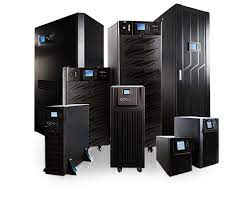
An uninterruptible power supply or uninterruptible power source ( UPS ) is an electrical apparatus that provides emergency power to a load when the input power source or mains powerfails. A UPS is typically used to protect hardware such as computers, data centers, telecommunicationequipment or other electrical equipment where an unexpected power disruption could cause injuries, fatalities, serious business disruption or data loss. UPS units range in size from units designed to protect a single computer without a video monitor (around 200 volt-ampere rating) to large units powering entire data centers or buildings.
Type of UPS
UPS have many type , but we always know 5 Type commonly use in several application
| Offline /Stand By | Line interractive | True Online Double Convertion |
|---|---|---|
| Verry Cheap | Cheap | Description |
| Load no isolated from utility | Load not isolated from Utility | Very Expensive |
| Large Transfer Time (up to 12-14 ms) | 2-4 ms transfer Time (Some Cases 4-8 ms | zero transfer time |
| Modified Sine wave / True Sinewave exceptional | MOdified sine wave (PWM) or True Sine Wave | Syncronized to the input phase when online |
| No Frequency Regulation | No Frequency Regulation | Description |
| NoTrue Battery Test Capability | Ripple Voltage on Battery | Rectifiesw the input AC Generated a true sinewave output via inverter Designed to always have full load on inverter |
| No ByPass | No By Pass | By Pass Funtionality (Static and Maintenance) |
| Only Able to run for short time (risk of overheating) | Some level of Voltage Regulation | Supply Regulated and Isolated Voltage and Frequency to the Load |
| Generally smaller KVA (Less than 2 KVA) | Generaly Smaller UPS KVA Output (Less than 5 KVA) | General Medium to Big UPS 10->100 KVA) |
| Only to Be used at non crticical PC Level | Onlyto be used at non crticval workstation level | Only Option for Mission Crtical Facilities |
U P S DataCenter
Uninterruptible power supply (UPS) systems secure uptime of large data centers and provide facility-wide protection for sensitive electronics. They have redundant configurations and dual bus capabilities to make sure your critical systems will keep running during power disturbances such as blackouts, brownouts, sags, surges or noise interference. These UPS systems allow modular configuration of a completely redundant power and control system, sized to match the capacity of the protected equipment. When power requirements change, capacity is easily added without increasing the system footprint. Some systems scale from 15 to 45kW in a cabinet configuration that includes internal batteries, or from 15 to 90kW in 15kW increments in a configuration that reserves a cabinet for capacity that is paired with an external battery cabinet. This approach allows for right-sizing of the UPS system, resulting in improved energy efficiency and reduced power expenditures. Data Center and Facility UPS systems are suited for server rooms, telecommunications or process control centers, remote facilities, enterprise data centers and collocation facilities.

Type of DC UPS
Two Tipe of UPS Technologies are used in Data Centre Environments : 1. Static UPS , Build Up Electronic components such as Ractifier , Inverter , Control Logic and Batteries. 2. Dynamic UPS , Build up out mechanical component such as Diesel engine , Power Generator and Flywheel (Kinetic Storage)
Static UPS
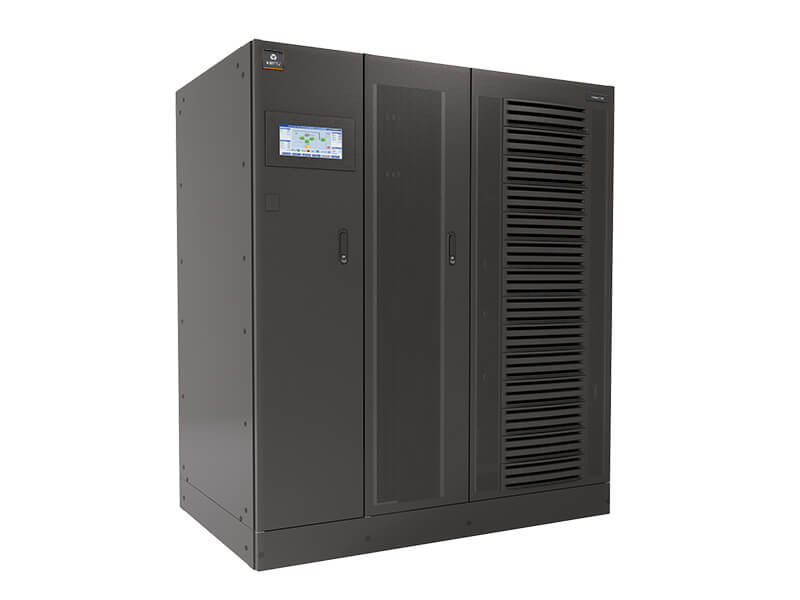
1. relatively complex power and Control Electronics 2. Requires a Controlled Environment 3. Requires Battery and Need to be replace every 3-4 Years for 5 Years Design life and Every 7-8 Years for 10 Year Design Life 4. One of the Oldest UPS technologies used for data center environment 5. Available in 500VA - 1.6 MVA in Single System

Dynamic UPS
1. only available in Higher KVA Ratings 2. Heavy , approx 8 Ton 3. More Noisy 4. Relative simple Design setup 5. No Need for Batteries for Energy Storage 6. No Need for Control Environment 7. Long Life Span 8. Good efficiency
UPS by Application
The critical systems that sustain your business operations can't go down. UPS supports you in improving your uptime with a full range of innovative uninterruptible power supplies (UPS) and future-proof, integrated UPS systems, that will cover the backup power needs of your IT infrastructure, from small computer rooms at the network edge to enterprise and hyperscale data centers. Discover the best uninterruptible supplies to protect your application. UPS for Data Center , Crtical Facility, Server Room, Coolocation/Hosting, Network Closet. Emergency Lighting and Desktop/Notebook
Modular UPS , The Latest Technology
Online Double Convertion

Online Double-conversion TopologyThe UPS adopts online double-conversion topology to provide the best power quality regardless of the conditions of incoming power. This topology also features a zero transfer time, ensuring optimal system operation.
Online Eco Mode

When the quality of utility power is good, the UPS switches to ECO mode to increase system efficiency. When the quality is unstable, the UPS switches to line mode to guarantee the best power quality.
Color LCD with Touch Panel
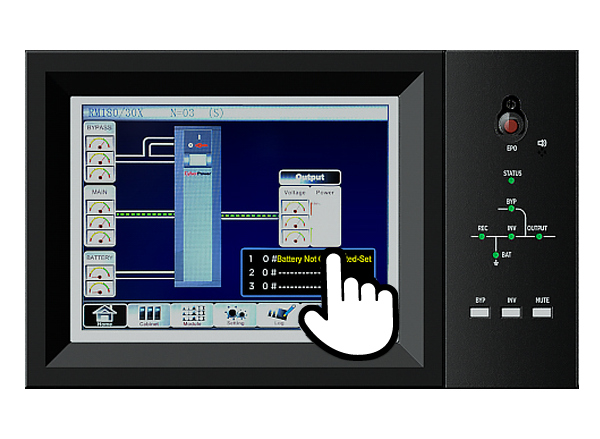
The color LCD with touch panel is designed with friendly, intuitive, and graphical user-interface, allowing users to monitor power system and configure settings by simply touching the screen.
Dual Input Design
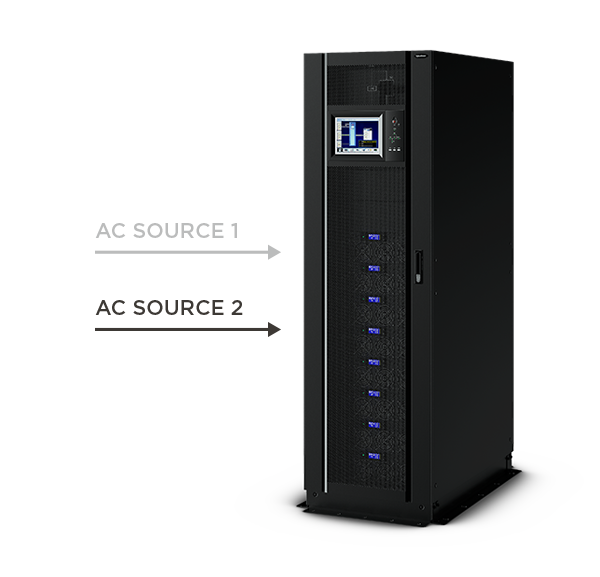
By allowing users to connect one input from AC power source and the second input from other power source, the dual power input design ensures high quality power and system continuity for connected equipment.
UPS Paralel Expansion
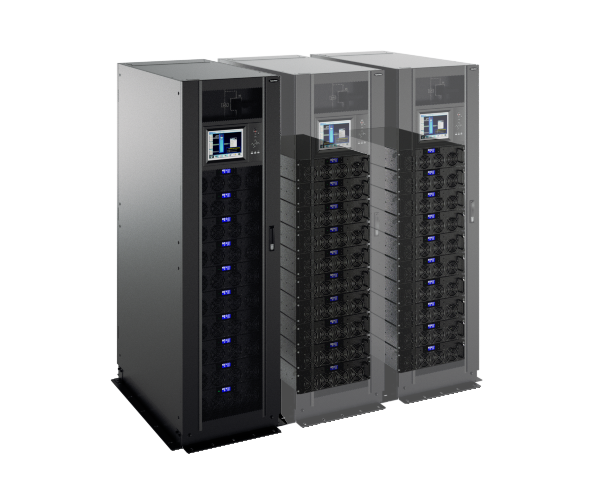
The UPS parallel expansion capability allows users to customize their power systems by connecting multiple UPS units, therefore reaching even higher capacity and achieving N+X power redundancy to protect the systems against power failures.
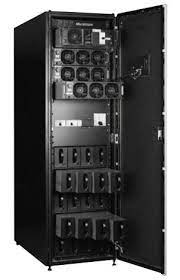
Vertical Scalability
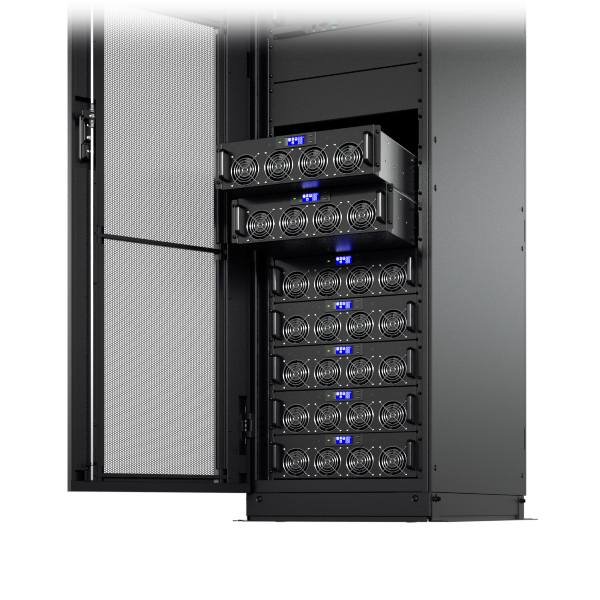
The number of power modules installed in the UPS can be customized based on power demands, without taking any extra floor space. The power modules are also hot-swappable, ensuring seamless operation.
Maintenance Bypass Switch

With this product, the operators can seamlessly switch the power to utility source via bypass mode, performing quick and safe maintenance without having to shut down the power system and connected equipment.
Generator Compatible

Power continuity can be achieved with generators during a power outage. When UPS is running on generator's power, it can stabilize unstable voltages from the generator while providing reliable power.
Emergency Power Off

Extended battery Module

The UPS can connect to extended battery modules (EBM) to prolong system runtime during power interruption. The EBM comes with plug-n-play DC connectors and supports EBM expansion, ensuring system's maximum power availability.
Smart Battery Management
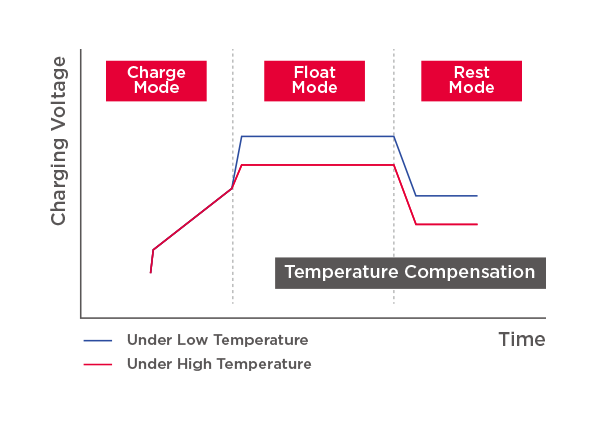
The UPS adopts Smart Battery Management (SBM) technology to manage the battery charging process by using a 3-cycle approach and temperature compensation, which efficiently extends the battery lifespan.
Remote Management
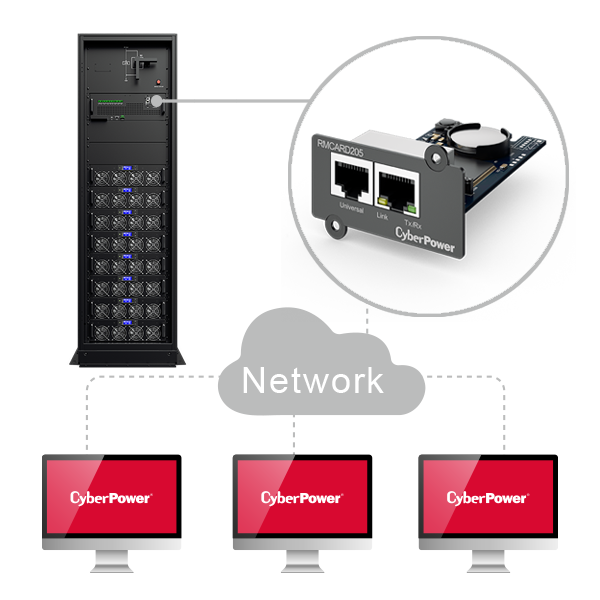
Remote management capability enables monitoring and controlling of devices through Remote Management Card. Users can also perform management tasks, such as scheduled shutdowns and reboots

Sample Title
Sample Text
Sample Title
Sample Text
Single Phase UPS
Single Phase UPS System (1/1) As shown in the chart, single phase UPS has a single input and output of 120Vac (for Canada and the U.S.). A single phase installation consists of two wires where AC voltage is a single sine wave. The standard voltage of single phase varies in different countries or regions. The standard single phase voltage in America is 120V and Europe, Asia or other regions take 230V as a standard voltage.
Thre Phase UPS
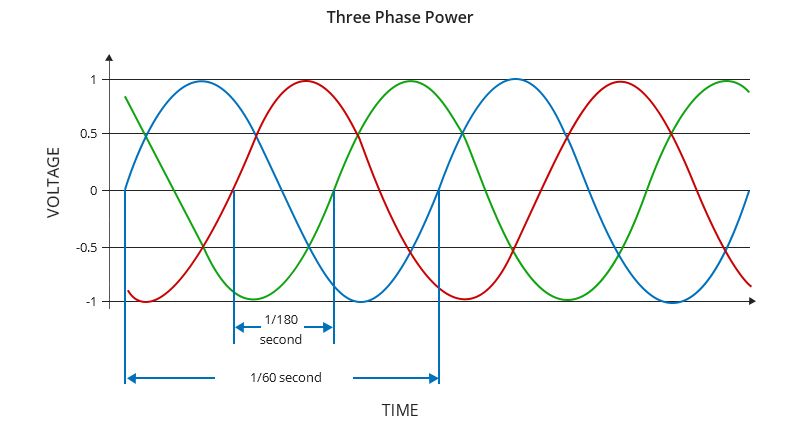
The three phase UPS can be subdivided into three phase input/three phase output UPS system and three phase input/single phase output system types. If you need to connect to a three phase supply, you must need a UPS with a 3/x configuration. A 3/1 UPS takes in 3 phase power but delivers single phase to the downstream load while a 3/3 UPS not only takes in but also puts out 3 phase power.
Diffrent Single Phase and Three Phase UPS
The key difference between single phase UPS and three phase UPS are the following points: Conductor: The number of the conductor in single phase and three phase system is different. Single phase UPS contains one conductor while three phase UPS supply power through three conductors. Sine wave: Single phase UPS provides a single sine wave, while three phase UPS provides three sine waves, each out of phase and spaced 120° apart from each other. Voltage: Single phase voltage is 120V in North America, while the phase to phase voltage for a three phase system is 220V, and the phase-to-neutral voltage is 120V. Maintenance: The plug and play characteristic of single phase UPS makes it easier than three phase counterpart to install and set up without the need for outside installation. Efficiency: For low power requirements, single phase UPS is more efficient that three phase UPS. But when the demand for power is higher, three phase UPS shows more efficiency to carry a greater load in a safer manner. Cost: The equipment in three phase UPS system will have longer life expectancies and the transmission lines for three phase power do not need the heavy gauge copper wires as single phase UPS, thus, in the long run, three phase UPS will save more money. Application: Single Phase UPS units are available in those applications with lower kVA requirements, generally less than 20kVA, such as homes, small business and satellite offices. Three phase UPS units are commonly used in large installations, such as data centers, and large industrial power applications with higher power requirements
Home UPS
UPS for homes at this time is very necessary, especially with the development of Internet technology which is now widely used at home such as Broadban Internet, Wifi etc. The condition of electricity in Indonesia, not all at all, are still disconnected, resulting in damage to the equipment used.
The criteria for a UPS that is used for homes do not require too high a specification as follow : Line-interactive UPS Topology Energy Saving Technology Automatic Voltage Regulation (AVR) Surge and Spike Protection LCD Status Display
From the UPS backup power is also not needed large, so it does not require a large source of charging and can perform backups of the device properly.
Office UPS
The Electric Backup System for the Office or Office is further increasing where the dependence on IT equipment is very high and the break or electricity problems occur in the office environment which will result in losses and disrupt operations.
System Backup for Office can be done centrally or independently on the device to be backed up. Determining these two things is very important because it will affect the preparation of electrical cable installation, panels and the price of the system that will be used
RELIABLE UPS TO PROTECT OFFICE EQUIPMENT • Line-interactive UPS Topology • Energy Saving Technology • Automatic Voltage Regulation (AVR) • Hot-swappable Batteries • PowerPanel® Management Software • Remote Management Capability
Industrial UPS
industrial UPS with single or three phase output are designed for the harsh industrial environment. The flexible system concept allows full compliance to the customer requirements with a wide range of options.
Application who need Industrial UPS : Power Generation Transmission and Distribution Oil and gas Infrastructure Manufacture railway Telecomunication Aviation
Besides the traditional Thyristor rectifier, UPS systems can be supplied with the leading A.T.I.S.® (Advanced Technology Industrial System) frontend based PFC (power factor correction) IGBT technology. This technology meets all common DC levels and offers a full galvanic isolation. Online managed battery testing with mains back-feed is another significant benefit of this advanced topology.